

Industries / Airports
Industry solution
Physical AI for airports.
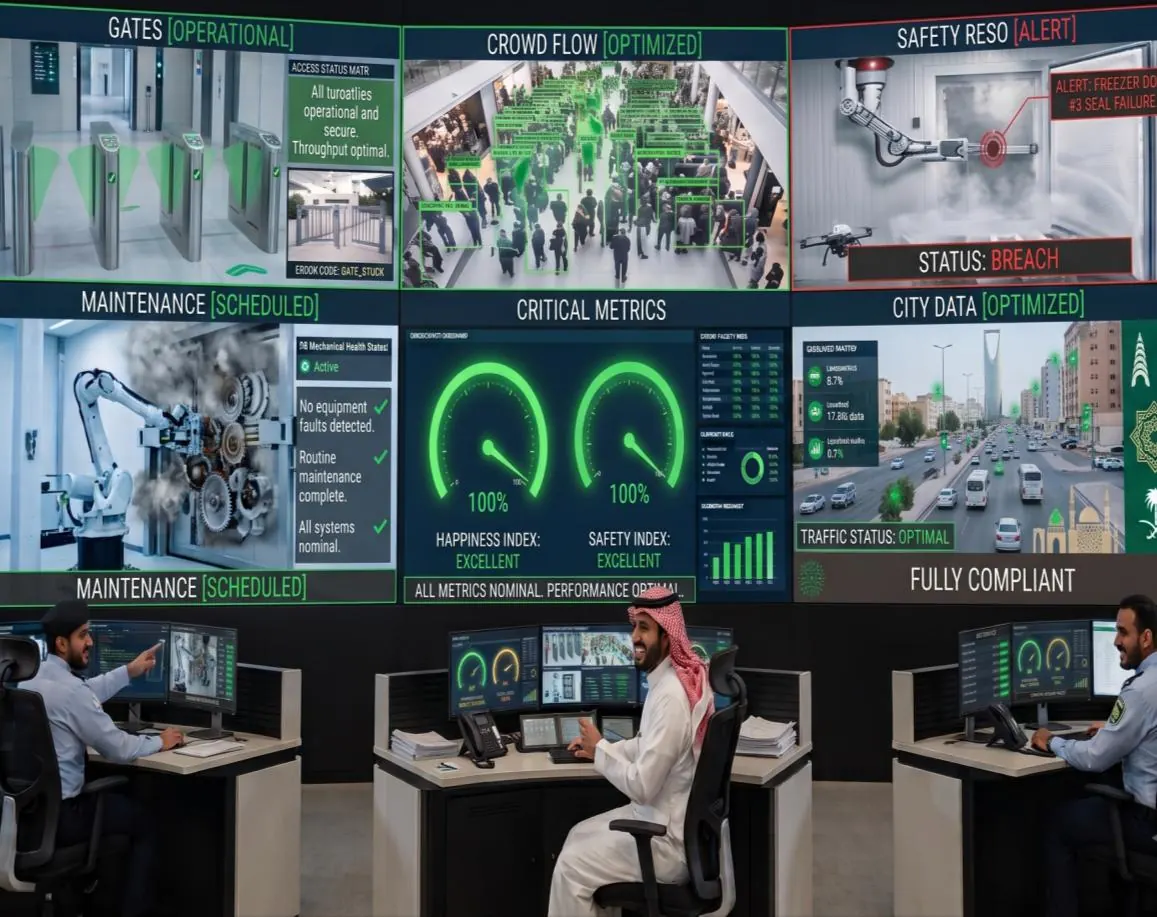
Move passengers smoothly and safely. EyeGo balances queues against SLAs, secures perimeters and airside zones, and finds lost people and baggage fast.
The challenge
What gets in the way today
- Queue SLAs missed at peaks
- Large camera estates, small control rooms
- Lost-person and baggage searches take hours
What you get with EyeGo
Outcomes on day one
- Passenger queue flow automation against SLAs
- Perimeter and secure-zone checkpoint alerts
- Cross-camera search for people and unattended baggage
- Kerbside and car-park ANPR, plus fire and smoke alerts
Use cases
Top use cases in airports & transit
Crowd management
See density and wait times per zone, predict SLA breaches and move staff before queues form.
Forensic search
Search thousands of hours of video by description, such as “person in a red jacket” or “black SUV”, and follow a path across cameras.
ANPR
Read Arabic and English licence plates, control gates, measure dwell at pumps and kerbs, and flag drive-offs, illegal parking and blocked lanes.
Fire detection
Spot smoke, flames, smoking near fuel, phone use on forecourts and unsafe acts on camera in seconds, and alert the site before a hazard becomes an incident.
Platform
Products behind this solution
FAQ
Frequently asked questions
How does EyeGo work in airports & transit?
Move passengers smoothly and safely. EyeGo balances queues against SLAs, secures perimeters and airside zones, and finds lost people and baggage fast. It connects to existing cameras and sensors, detects events at the edge, and sends each issue to the right person as a task that is closed with proof.
Do we need new cameras or a cloud connection?
No. EyeGo works with existing IP cameras from any brand and can run fully on-premise, including air-gapped deployments.
How do we start?
With a 30-day Proof of Value at one to five sites. EyeGo measures your baseline first, then reports the change on your own data.
See EyeGo on your own sites in 30 days.
Plug-and-play edge devices at one to five sites, no disruption to operations, and a report on risks reduced and hours saved, measured on your data.